
If there is no third wave of the pandemic, the fiscal position of the Centre and the states will be much better than budgeted for FY22 and the states may garner Rs 60,000 crore more in tax collections at Rs 8.27 lakh crore this fiscal year than they have budgeted, a report said. The report by SBI Research on Monday bases its optimism on GST collection so far this fiscal, which has been the best ever in spite of the fact that the two months bore the maximum brunt of the second wave -- with April setting a record Rs 1.41 lakh crore and May collection a tad low at Rs 1.03 lakh crore. The report also said overall government finances do not look overstretched as GST collections have continued to maintain pace so far and the additional fiscal impact arising from free vaccination and more food supplies will only be around Rs 28,512 crore.

In absolute terms, the fiscal deficit -- the difference between expenditure and revenue -- was Rs 6.12 lakh crore during April-November 2017-18

The output of eight core sectors grew by 16.8 per cent in May, mainly due to a low base effect and uptick in production of natural gas, refinery products, steel, cement and electricity, official data released on Wednesday showed. The eight infrastructure sectors of coal, crude oil, natural gas, refinery products, fertilisers, steel, cement and electricity had contracted by 21.4 per cent in May 2020 due to the lockdown restrictions imposed to control the spread of the COVID-19 infections. In March this year, these key sectors had recorded a growth of 11.4 per cent, and 60.9 per cent in April.
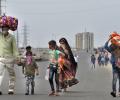
Finance secretary Ajay Bhushan Pandey on Sunday hinted that the government was working on another stimulus package but he refrained from giving a timeframe.

Petrol price on Thursday was cut by Rs 6.07 per litre and diesel price by Rs 11.75 in Delhi as oil companies passed on a record reduction in excise duty rates to consumers. Buckling under pressure, the government had on Wednesday cut excise duty on petrol by Rs 5 per litre and that on diesel by Rs 10 a litre to give reprieve to consumers battered by record high retail fuel prices. Since states charge local sales tax or VAT not just on the base price but also on the excise duty levied by the centre, the total incidence of price reduction is higher.
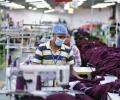
'The finance minister said, the MSME is the backbone of the economy. My question is, what have you done for the sector?'

With the first quarter gross tax mop-up reaching Rs 5.6 lakh crore, Icra Ratings on Friday said the government is set to exceed the budgeted tax collection target of Rs 22.2 lakh crore for 2021-22, led by indirect taxes. The government has budgeted a modest 9.5 per cent growth in tax collections at Rs 22.2 lakh crore for FY22, over FY21 collections of Rs 20.2 lakh crore. However, despite the second wave of the pandemic, the April-June quarter tax collections rose to Rs 5.6 lakh crore, which is 39 per cent higher than Q1 of FY20.
The budgeted indirect tax collection target is Rs 9.26 trillion, and the Centre has collected around Rs 5 trillion in the first 8 months. So it needs another Rs 4.2 trn in the last four months

The challenge before the government now is to use the factors that are favourable to its benefit.

"Had corona (COVID-19) not been there, the prime minister would have dedicated NATGRID to the country. I am hopeful that the prime minister will dedicate NATGRID to the country in some time," Union home minister Amit Shah said during the 51st Foundation Day event of the Bureau of Police Research and Development (BPRD) here on September 4.
After the April-July fiscal deficit data was released on August 31, several analysts hinted that the government may need to go for cuts in capital expenditure to meet the fiscal deficit target.

The GDP slumped to a three-year low lagging China for the second straight quarter -- as manufacturing slowed ahead of the GST launch amid demonetisation effect.

'One way to deal with these is to address these quickly and have rapid reaction teams in New Delhi, the state capitals and wherever possible.'

However, economic growth in five years of the UPA and NDA cannot be compared because of the now complex back series data, reports Indivjal Dhasmana.

The Delhi high court on Wednesday allowed Chinese smartphone maker Vivo to operate its various bank accounts frozen by the Enforcement Directorate in connection with a money-laundering probe subject to furnishing of a bank guarantee of Rs 950 crore within a week with the agency. Justice Yashwant Varma also directed the company to give details to ED about its remittances and issued notice to the investigating agency on Vivo's plea seeking quashing of the order freezing its various bank accounts. ED contended that presently the proceeds of crime have been quantified to Rs 1200 crore.

She also took a swipe at the Bharatiya Janata Party over its defeat in the just-concluded Himachal Pradesh assembly elections, saying the ruling party's president could not hold on to his home state. "Who is the Pappu now?" she asked.

'India's manufacturing will take 10-15 years to catch up with China.'

Tharoor argued that the proposed bill represents a "grave chapter in the history of the Indian republic, seeking to ratify an ordinance that in many ways is an assault on our democratic heritage and the spirit of federalism."

The 30-share barometer remained up throughout and hit a high of 29,070.20, powered by a rally in RIL and other blue-chips. The index ended 215.74 points up, or 0.75 per cent, at 29,048.19 -- its highest closing since March 5, 2015, when it had closed at 29,448.95.

Prime Minister Narendra Modi Wednesday said the International Monetary Fund (IMF) sees India as a "bright spot" in the global economy and as per the World Bank, India is in a better position to deal with the global headwinds than many other countries. This is because of India's strong "macroeconomic fundamentals", Modi said while virtually addressing the inaugural function of the 7th edition of Invest Madhya Pradesh-Global Investors Summit in Indore. In the past eight years, the government has increased the speed of reforms and removed many hurdles in the way of investments.

Chief Economic Adviser K V Subramanian has said the economy was "experiencing a V-shaped recovery" after the lockdown was eased.

Foreign portfolio investors (FPIs) were net buyers to the tune of Rs 16,459 crore in Indian markets in August, with majority of investment coming in the debt segment. In equities, they invested just Rs 2,082.94 crore while debt segment saw inflow of Rs 14,376.2 crore between August 2-31, depositories data showed. The quantum of investment in the debt segment is highest in this calender year so far.

The rates of price rise in many services used by the common man, including hospital and nursing, cook, domestic help and bus (fare), among others, have also touched double digits during the last four years, putting a burden on disposable income.

as the FAME II deadline of March 31, 2024, nears, EV manufacturers are worried about their investments and future plans.
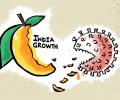
Those hardest hit by the second wave of the pandemic have been blue-collared workers, doctors and healthcare workers, law and order and municipal personnel, individuals eking out daily livelihood, and small businesses. And there should be more measures taken to alleviate their pain, the Reserve Bank of India (RBI) said on Monday. The report also indicated that the RBI's growth numbers might have to be revisited as the central bank's real GDP growth projection of 26.2 per cent given in the MPC's resolution of April 7 for the first quarter of 2021-22, were "made before the full fury of the resurgence." Nevertheless, the "resurgence of COVID-19 has dented but not debilitated economic activity in the first half of Q1: 2021-22.

The Congress president alleged that the surgical strike was made public as the BJP was fighting elections in Uttar Pradesh.
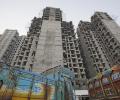
Housing prices may rise 5 per cent next year on improved demand, according to Knight Frank India. In its '2022 Outlook Report', the property consultant said: "While 2021 was mostly impacted by the volatility due to the pandemic, 2022 may prove to be a more stable year for the sector both for commercial as well as the residential sector." On the housing segment, the report said that sales momentum is expected to continue in 2022 as prospective homebuyers' preferences for bigger homes, better amenities, and attractive pricing will keep them interested to seal the deals.

'Overall, compared to the previous episode, we are in a better shape because the vaccine is already out there and vaccination drives are proceeding'

'When the average growth in the last three years was just 2.5%, how does that make us the fastest growing country?' 'They only tell you what has happened in the last 2 years; they are not taking into account what happened in FY21 on account of their mistakes.'
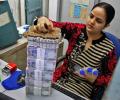
'The Budget numbers presented severely underestimate the magnitude of the unstated fiscal crisis that we went through in 2018-2019, which cannot be conceivably be fully reversed in 2019-2020,' points out Rathin Roy, director, National Institute of Public Finance and Policy.
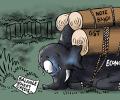
'The current budgetary practice of shifting expenditures off-balance sheet in order to be seen to be meeting fiscal targets should be discontinued; additional fiscal stimulus would be imprudent; individual income tax rates should not be cut; GST rates should not be raised now,' advise Arvind Subramanian and Josh Felman.
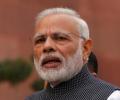
Modi said officers must fix clear targets to improve the country's tax administration by 2022, the 75th anniversary of Independence.

Vegetable prices which had witnessed a 21.16 per cent contraction in June, shot up by 21.95 per cent in July.

'Good investment opportunities should not be missed.'

Indian companies are expecting generous tax incentives from the Union Budget that will help them invest more in building capacities in the coming years. While the productivity-linked incentives (PLIs) are a good start to spur local manufacturing, the government should also take steps to boost consumer demand, which is not showing encouraging signs, say chief executive officers (CEOs) of India Inc. Statistics released by the Reserve Bank of India (RBI) shows that Indian banks had sanctioned loans worth Rs 75,558 crore in 220 new projects - a record low - in the pandemic-hit financial year ending March 2021. This is not showing any signs of a significant pick up in the last nine months of the ongoing financial year.

Responding to a question on the Rajasthan government's claim that there is a shortage in COVID-19 vaccine stock, Union Health Secretary Rajesh Bhushan said the central government regularly monitors the availability of vaccine supply in all states and UTs and their consumption on a daily basis.

Optimistic buying in blue-chip stocks ahead of release of industrial production data for July and retail inflation for August drove stocks higher.

Most rating agencies had projected contraction in India's GDP for the first quarter of 2020-21.

Annual premiums do not exceed what you readily shell out for an OTT subscription.

Earlier in May, Ford India announced that it had dropped its plans to make electric vehicles (EVs) in India, which it intended to export, under the production-linked incentive scheme (PLI). Ford was among 20 companies that had signed a Champion OEM Incentive Scheme under the PLI project with the government in February this year. The decision comes as a blow for the 4,000-odd employees at Ford India's Maraimalai Nagar plant near Chennai and in Sanand, Gujarat. In September last year, the company had announced that it would exit the India market, which it had entered in 1995 through an on-again, off-again joint venture with Mahindra & Mahindra (they split in 1998, signed a JV in 2019 and split again in December 2020), retailing petrol and diesel brands such as the EcoSport, Figo, Aspire, and Endeavour.
